Disclaimer: This guide is intended exclusively for authorized cybersecurity penetration testing and defensive security research. Unauthorized use of attack dictionaries to access systems or accounts without explicit permission is illegal and unethical.
1. Overview of Bixin Offline Attack Dictionaries
A Bixin-specific offline attack dictionary is a curated list of password candidates designed for offline password auditing scenarios targeting Bixin platform-related account systems (e.g., locally stored password hashes, offline credential verification modules). Unlike generic password dictionaries, Bixin-focused dictionaries are optimized for password patterns common among Bixin users, significantly improving the efficiency of authorized offline security tests.
2. Preparations Before Dictionary Construction
Before creating a custom dictionary, complete the following preparatory work to ensure relevance and compliance:
- Confirm written authorization from the asset owner for offline password testing
- Collect publicly available, legally obtainable information related to Bixin (e.g., platform naming conventions, common user password patterns from public security reports)
- Prepare standard dictionary generation tools:
crunch,cupp,hashcat, and deduplication utilities likesortanduniq
3. Core Methods for Bixin Offline Attack Dictionary Creation
3.1 Rule-Based Generation
This method uses fixed password pattern rules to generate targeted dictionaries, suitable for scenarios where Bixin user password habits are partially understood (e.g., users often combine Bixin-related keywords with dates or special characters).
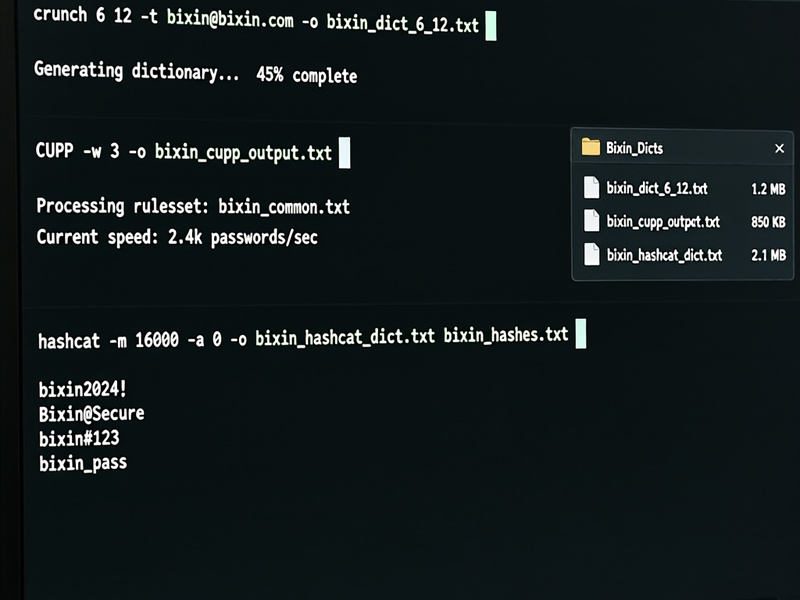
Operation example with Crunch:
Run the following command to generate 8–12 character passwords with the "bixin" prefix followed by 4–6 digits:
crunch 8 12 -t bixin%%%% -o bixin_rule_based_dict.txt
You can adjust character sets (e.g., add special characters, mixed case) based on actual password policy research.
3.2 Social Engineering Custom Generation
Use the Common User Passwords Profiler (CUPP) tool to generate highly customized dictionaries by inputting Bixin-related social engineering information, such as platform slogans, common promotion keywords, and target user group characteristics.
Steps:
- Launch the CUPP tool in interactive mode
- Input collected Bixin-related keywords (e.g., platform name, product lines, anniversary dates)
- Configure password combination rules (e.g., keyword + year, keyword + special symbol, case flipping)
- Export the generated custom dictionary
3.3 Legally Sourced Leaked Data Filtering
For authorized security research, you can filter password entries related to Bixin accounts from legally obtained, publicly available security breach datasets for research purposes. After deduplication, invalid entry removal, and format standardization, these entries form a high-value real-user password dictionary.
Optimization tips:
- Use
sort bixin_leaked_dict.txt | uniq > bixin_cleaned_dict.txtto remove duplicate entries - Filter out passwords that do not match Bixin's password length and complexity rules
3.4 Combined Rule Amplification
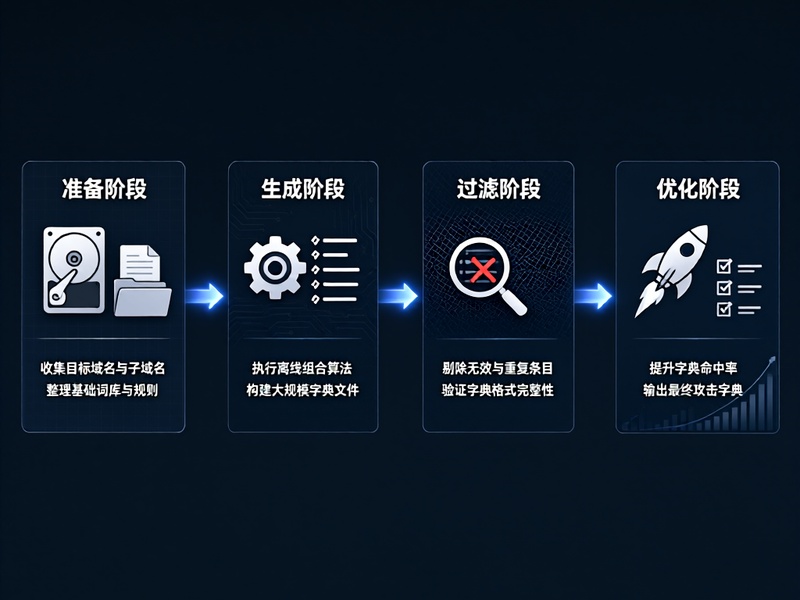
Use Hashcat's rule engine to combine basic dictionaries with Bixin-specific prefixes, suffixes, and mutation rules to expand the dictionary scale while maintaining targeting.
Example rule set:
Add the following rules to a bixin_rules.rule file to append common Bixin-related suffixes to each base password:
$b $i $x $i $n
$b $i $x $i $n $2 $0 $2 $4
$b $i $x $i $n $!
Run the generation command:
hashcat --stdout base_dict.txt -r bixin_rules.rule > bixin_combined_dict.txt
4. Best Practices & Compliance Requirements
- Strict Legal Compliance: Always obtain explicit written authorization from the asset owner before using any attack dictionary for testing
- Dictionary Optimization: Regularly update and clean the dictionary to remove invalid entries and reduce unnecessary computational overhead
- Defensive Purpose Orientation: The dictionary is only used to test the strength of Bixin-related account systems and improve security protection capabilities, and must not be used for illegal access or data theft