SeedSigner-style wallets often depend on a BIP39 mnemonic phrase. If you generated the seed yourself, or if you are working from a handwritten backup, memory can still become unreliable after months or years. Words feel familiar, but the order seems shuffled. This is not a simple typo problem; it is a structured recovery problem with constraints.
First rule: protect the seed while you think
- Work on an air-gapped device if possible.
- Never type the full phrase into websites, AI tools, cloud notes, or email.
- Do not send partial phrases to strangers claiming to help.
- Use only local, auditable tools for validation.
- If you only have a public receiving address, compare derived addresses offline; do not expose private keys.
Understand what you are trying to recover
A BIP39 phrase is usually 12, 15, 18, 21, or 24 words from a fixed wordlist. Each word represents 11 bits of entropy, and the last word contains checksum bits. For a 12-word phrase, the checksum is four bits, meaning many random arrangements will fail instantly. That is your recovery advantage.
SeedSigner-style setups may also involve:
- a language setting such as English or Spanish,
- an optional passphrase,
- a specific derivation path,
- a known first external receiving address.
If any of those are wrong, the recovered words may still not produce the expected wallet. Recovery is therefore a multi-layer puzzle: phrase order, word identity, language, passphrase, and derivation path.
Map the confusion before attacking it
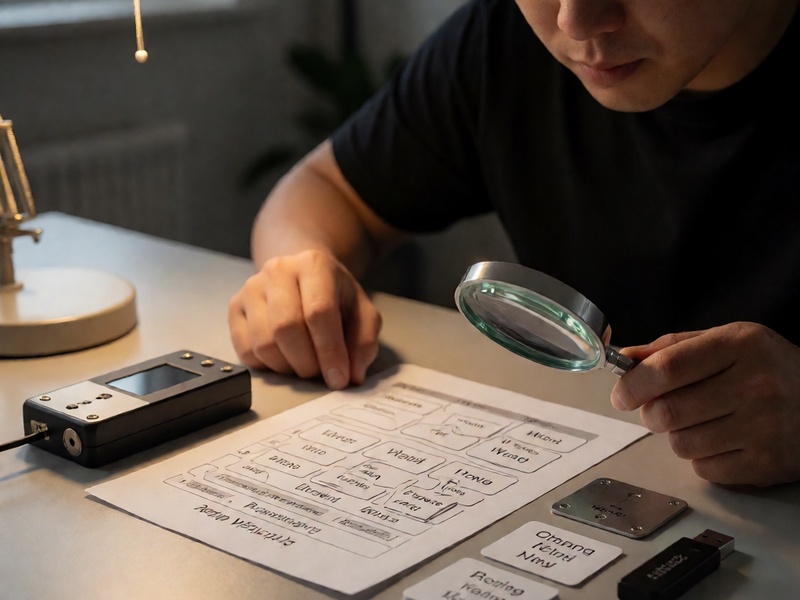
Create a recovery worksheet with these columns:
| Area | What to capture |
|---|---|
| Known words | Words you are certain about, with position notes |
| Possible swaps | Two or three words that may be reversed |
| Similar words | Pairs like couch versus caution, or pigeon versus pilot |
| Language drift | English versus translated BIP39 list |
| Missing positions | Which slots you cannot recall |

| Confidence score | High, medium, or low for each position |
The table can be simplified:
- position 1: high confidence
- position 4: medium, possibly swapped with position 5
- position 12: low, checksum-sensitive
Use BIP39 checksum as a filter, not a brute-force engine
The safest approach is constrain first, test second:
- Lock the phrase length. If your backup says 12 words, do not test 24-word combinations unless you have clear evidence.
- Keep likely words fixed while shuffling only uncertain slots.
- Test each candidate locally against the BIP39 checksum.
- For candidates that pass checksum, derive the expected public addresses offline.
- Stop after a bounded search. If you have more than a few unknown words, the space grows too fast to treat casually.
Checksum testing does not prove you found the correct seed. It only proves a candidate could be a valid mnemonic. Address matching is the stronger check when you have a known receiving address.
Practical permutation patterns
When memory feels chaotic, organize possibilities into patterns.
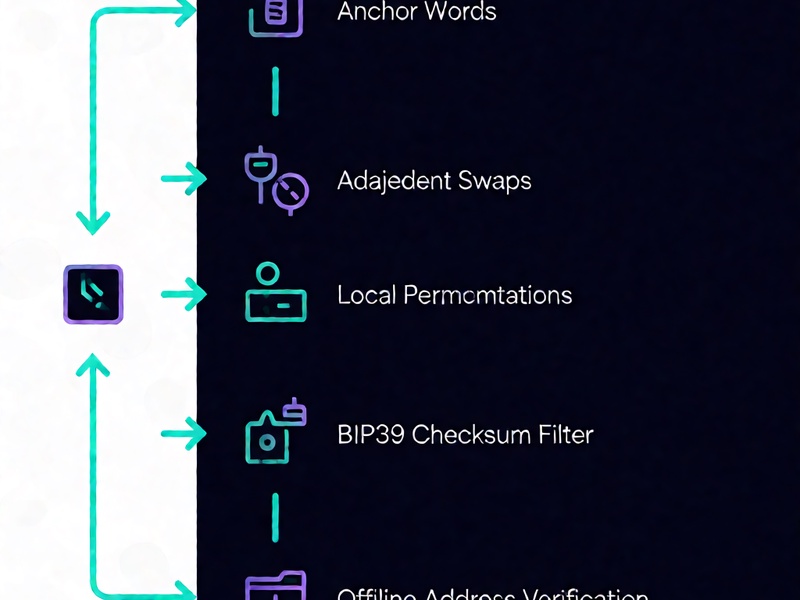
Anchor-and-swap recovery
Choose two or three words you are most confident about. Hold them fixed. Swap the remaining uncertain words in adjacent positions.
- Example pattern: word 1 fixed, words 4 and 5 reversed, words 7 through 12 shuffled in pairs.
This works well when you remember fragments but not sequence.
Local-window shuffling
Divide the phrase into windows: positions 1-4, 5-8, and 9-12. Shuffle only inside a window before crossing windows. This keeps familiar chunks intact and reduces unrealistic combinations.
Candidate-set substitution
For a word you are unsure about, do not guess one random word. Build a candidate set:
- The word you half-remember
- Nearby words from the BIP39 English list
- Words from a translated list if language drift is possible
- Words with the same first letter
- Words that share a mnemonic association from the original setup
Then test only plausible substitutions in the relevant position.
Adjacent-pair reconstruction
If the phrase feels like pairs got mixed, create a list of remembered adjacent pairs:
- word 3 plus word 4
- word 9 plus word 10
Pair constraints reduce order permutations dramatically and can reveal a broken sequence without full recovery attempts.
When language confusion is part of the problem
BIP39 wordlists are language-specific. If you used a translated backup, a word may exist in one list but not another. Recovery steps:
- Confirm whether the original SeedSigner flow was set to English or another language.
- Do not mix wordlists unless you intentionally test them as separate scenarios.
- Check whether the last word checksum pattern matches the expected language list.
- Remember that translated words may sound similar to English terms, increasing memory errors.
What if the passphrase may be wrong?
A passphrase can make a valid mnemonic produce a different wallet. If recovery seems to fail after the words are correct, test the passphrase matrix carefully:
- empty passphrase
- capitalization variants
- extra spaces
- old email fragments
- device names or nicknames
Never guess passwords online. Keep this offline too.
A sensible search budget
Set limits before you begin:
- If one word is uncertain and its position is known: test a small candidate list, not every word.
- If two words are uncertain: test adjacent swaps and checksum-valid permutations first.
- If more than two positions are uncertain: stop and consider whether you have a better backup source.
- If many candidates pass checksum but no address matches: suspect language, passphrase, or derivation path, not just the mnemonic.
A bounded process is safer than a desperate endless search.
Final verification without exposing secrets
If you have a known public address:
- Use a trusted offline derivation tool.
- Derive a small set of external addresses from the candidate seed.
- Compare only the public address text.
- Keep the private derivation environment isolated.
- Record which candidate worked, then rebuild backups in a controlled way.
If you do not have any known address, be extra cautious. A checksum-valid phrase may still not be your funds.
Prevent the next memory shuffle
The best recovery tool is a better backup:
- number each word 1 through 12
- write the wordlist language
- note whether a passphrase was used
- store multiple offline copies
- test a recovery path using a throwaway seed before trusting a high-value seed
- keep derivation path notes separately from the mnemonic
SeedSigner mnemonic confusion is often not a memory failure alone. It is a failure of structured backup design. With anchors, checksum constraints, bounded permutations, and offline verification, you can turn chaos into a methodical recovery process.
This article is general educational guidance, not a guarantee that every memory-based recovery will succeed. If large amounts of funds are involved, prioritize privacy, offline testing, and conservative scope limits over risky online attempts.