Introduction
A crypto wallet can look empty even when your funds still exist. In many recovery cases, the seed phrase is correct, but the wallet is looking at the wrong BIP32 derivation path. This article explains the BIP32 derivation path asset recovery method: how hierarchical deterministic wallets derive keys, why paths matter, and how to scan, recover, and secure assets offline. It is part of the Crypto Wallet Recovery Guide, and the root resource at / can help you build a wider recovery checklist.
What BIP32 Does in Wallet Recovery
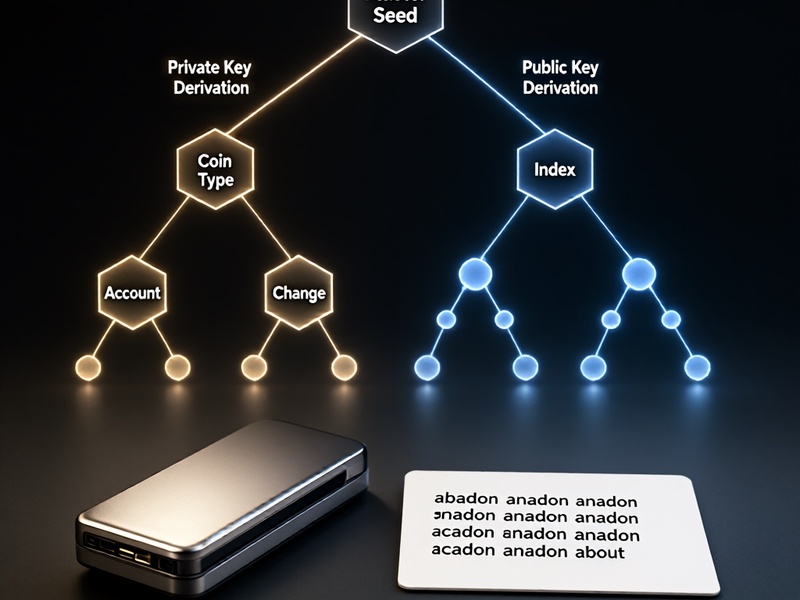
BIP32 defines hierarchical deterministic (HD) wallets. One seed produces a master key, and child keys are derived along a tree. A derivation path is written like this:
m / purpose' / coin_type' / account' / change / address_index
Key points:
- The
mmeans master key. - An apostrophe means a hardened derivation step.
purposeoften follows BIP44, BIP49, or BIP84.coin_typeseparates assets, such as Bitcoin and Ethereum.account,change, andaddress_indexidentify the exact address branch.- The same seed can generate many different wallets depending on the path.
This is why a seed phrase is not tied to one visible address. It is tied to a tree of possible addresses.
Why the Wrong Derivation Path Makes Assets Appear Lost
If you restore a seed phrase in MetaMask, Electrum, Ledger, or another wallet and see a zero balance, the wallet may be searching a different path than the one that originally held your funds.
Common causes include:
- Using a Bitcoin legacy path when the funds were received on a SegWit path.
- Restoring an Ethereum seed in a wallet that expects a different account index.
- Forgetting a BIP39 passphrase, sometimes called the 25th word.
- Scanning only the first address instead of the account, change, and index range.
- Using a wallet that does not scan enough addresses beyond the gap limit.
BIP32 derivation path recovery is the process of checking the likely branches until the original addresses and balances are found.
Common Derivation Paths to Scan
Use this as a starting point. Always verify with the original wallet type and transaction history.
| Asset or wallet | Common derivation path | Recovery note |
|---|---|---|
| Bitcoin Legacy BIP44 | m/44'/0'/0'/0/0 | P2PKH addresses, often from older wallets |
| Bitcoin Nested SegWit BIP49 | m/49'/0'/0'/0/0 | P2SH-P2WPKH addresses |
| Bitcoin Native SegWit BIP84 | m/84'/0'/0'/0/0 | Bech32 addresses starting with bc1 |
| Ethereum, MetaMask, MyEtherWallet | m/44'/60'/0'/0/0 | Scan account and index ranges, such as 0/0, 0/1, 0/2 |
| Ledger Live Ethereum | m/44'/60'/0'/0/0 | Account index can change if multiple accounts were used |
| Electrum standard wallet | Often m/0/0 or BIP84-style paths | Use Electrum recovery and scan receiving plus change chains |
| Old Bitcoin Core wallet.dat | Not purely BIP32 | Use Pywallet for key extraction and btcrecover or HashCat for password recovery |
Coin types also matter. Bitcoin commonly uses 0, Ethereum uses 60, Litecoin uses 2, and Bitcoin Cash often uses 145.
Step-by-Step BIP32 Derivation Path Recovery
1. Prepare an offline environment
Security comes first. Use an air-gapped computer, a live Linux USB, or a trusted offline machine. Disconnect from the internet, disable cloud sync, and avoid screenshots or web forms. Entering a seed phrase into a phishing site can permanently expose your assets.
2. Gather known facts
Write down what you know:
- Full or partial seed words and their order.
- BIP39 passphrase, if one was used.
- Original wallet app or hardware device.
- First receiving address, if remembered.
- Transaction history, exchange withdrawal records, or old backups.
- Extended public key, extended private key, or wallet file.

3. Reconstruct or verify the seed
If the mnemonic is complete, verify the BIP39 checksum offline. If it is partial, use the BIP39 wordlist, known word positions, and checksum rules to narrow candidates. Tools such as btcrecover and seedrecover can help with offline dictionary attacks when used on wallets you own.
4. Derive keys offline
Use a trusted offline BIP39/BIP32 tool or a wallet with path selection. Enter the seed and scan common paths. If you have an xprv, you can derive private keys. If you only have an xpub, you can create a watch-only scan and compare addresses without exposing private keys.
5. Scan systematically
Do not stop at the first address. Scan:
- BIP44, BIP49, and BIP84 for Bitcoin.
- Ethereum paths for MetaMask, MyEtherWallet, and Ledger-style accounts.
- Change chains, usually
0for external and1for internal. - Account indexes, from
0to at least5or more if needed. - Address indexes beyond the standard gap limit. If no funds appear, increase from 20 to 100 or higher.
6. Verify addresses and balances
Compare derived addresses with old transaction records or known receiving addresses. A match confirms the correct path. If the wallet shows balances, verify the transaction history before moving funds.
7. Sweep to a new secure wallet
Once recovered, send assets to a newly generated wallet with a fresh seed. Do not keep using a seed that may have been exposed during recovery. If possible, sign transactions offline and broadcast from a clean device.
Recovering from Partial Mnemonics and Forgotten Passwords
Partial mnemonic recovery is possible, but it must be done offline. Use the official BIP39 English wordlist, preserve known words, and let checksum validation remove bad guesses. For advanced searches, btcrecover and seedrecover can test word combinations and common mistakes.
Password recovery is a separate problem from seed recovery:

- btcrecover can help with some Bitcoin Core and Electrum wallet passwords.
- HashCat can test password hashes from supported wallet formats.
- Pywallet can extract keys from older Bitcoin
wallet.datfiles. - Hardware wallet PIN loss is usually not recoverable without the seed phrase. If the device is damaged, restore the seed in a compatible wallet and scan the correct BIP32 derivation paths.
Never use online cracking services that ask for your seed or wallet file.
Derivation Path Recovery with xprv, xpub, or Address Clues
If you have an extended private key, import it into a compatible wallet and check the active path. If you have an extended public key, you can scan addresses in watch-only mode. If you only have an old address, use it as a target while scanning common paths and index ranges.
The gap limit is critical. Many wallets stop searching after 20 unused addresses. A recovery scan should usually go much farther, especially if the wallet was used for many transactions or change addresses.
Common Mistakes and Safety Rules
- Never enter a seed phrase on a website, chat, email, or cloud note.
- Do not assume one derivation path fits every wallet.
- Do not ignore a BIP39 passphrase.
- Do not confuse a wallet password with a seed phrase.
- Do not use a low gap limit when scanning.
- Do not run recovery tools on an internet-connected machine.
- Only recover wallets you own or are legally authorized to access.
Prevention: Avoid Future Derivation Path Problems
- Back up the seed phrase in multiple secure locations, including metal backups if possible.
- Record the wallet type, coin, and derivation path used for important accounts.
- Test recovery before storing large balances.
- Consider sharded or multisignature backups for high-value holdings.
- Keep hardware wallet firmware and recovery software from trusted sources.
- Store cold wallet backups separately from passwords and devices.
Conclusion
BIP32 derivation path recovery is a methodical process: secure the environment, reconstruct the seed, scan the right paths, verify addresses, and move funds to a fresh wallet. When a restored wallet shows nothing, the answer is often a path mismatch rather than a lost seed. With offline tools such as btcrecover, HashCat, Pywallet, Electrum, MetaMask, and a careful BIP32 scan, many apparent losses can become recoverable. For more structured help, use the Crypto Wallet Recovery Guide and start from the root resource at /.