Custom recovery script development for Litecoin-specific versions is a focused discipline: it combines wallet-format research, version-aware parsing, and offline password or seed testing. If you are trying to recover a Litecoin Core wallet.dat, an Electrum-LTC seed, or a legacy backup, the wrong script can waste time or risk exposing keys. This guide explains a safe, practical workflow and points to Crypto Wallet Recovery Guide for broader wallet recovery checklists and tool reviews.
Why Litecoin Recovery Scripts Need Version Awareness
Litecoin looks similar to Bitcoin at the code level, but recovery scripts must account for Litecoin-specific constants: coin type 2 in BIP44 paths, address prefixes such as L, M, and ltc1, WIF encoding, and wallet software differences. Litecoin Core wallet.dat files from different releases may use Berkeley DB layouts, encrypted master keys, HD key metadata, or descriptor wallets. Electrum-LTC uses its own seed derivation and versioned seed schemes. A script that assumes one format may parse the file but fail to validate the correct address.
Before writing code, identify the source wallet. If the wallet opens in a compatible Litecoin Core version, commands such as litecoin-cli getwalletinfo and getaddressinfo can reveal the wallet format and descriptor status. If it does not open, work from a copy and inspect version metadata with a read-only parser. Never test experimental scripts on your only wallet file.
A Safe Custom Recovery Workflow
- Preserve evidence. Copy the wallet, seed backup, and notes to encrypted offline media. Record checksums and work only on duplicates.
- Map the version. Match the wallet software and release to its expected format: legacy Litecoin Core wallet.dat, descriptor wallet, Electrum-LTC seed, or exported private key.
- Define the missing secret. Decide whether you are recovering a passphrase, a mnemonic phrase, a WIF key, or an encrypted master key. Each needs a different verifier.

- Build a modular script. Separate parsing, candidate generation, derivation, and verification. This lets you swap Litecoin-specific adapters without rewriting the whole tool.
- Verify offline. Use an air-gapped machine, disable networking, and test only against derived addresses or known public keys. Do not print candidate passphrases to shared logs.
- Validate before export. Confirm recovered material by deriving the expected Litecoin address and checking it against a known transaction or backup record.
Litecoin-Specific Script Modules
Wallet parser adapter. Detect Berkeley DB or SQLite, legacy or descriptor wallets, and encrypted or unencrypted master keys. For older Litecoin Core backups, confirm the Berkeley DB version and avoid modifying the file in place.
Derivation adapter. Use Litecoin coin type 2 for BIP44-style paths when appropriate, and support Litecoin address encoding for legacy and SegWit formats. For Electrum-LTC, follow its seed version rules rather than assuming a generic BIP39 flow.
Candidate engine. Start with targeted dictionaries, known variations, and rules based on your own memory. Only then move to masks or broader attacks. A small, well-designed candidate list is usually safer and faster than a noisy brute-force run.
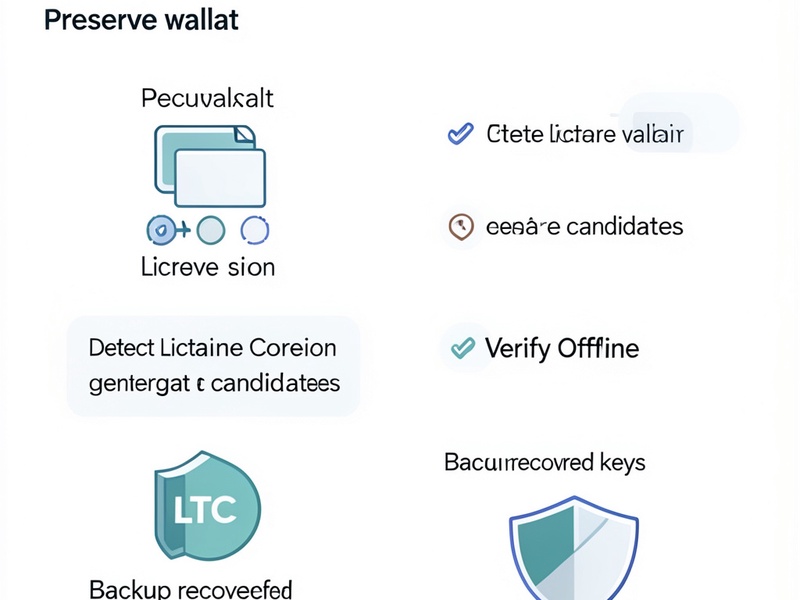
Verifier. Decrypt in memory or derive the target address, then discard failed candidates. Keep logs redacted and store only hashes or counts, not secrets.
Reporting layer. Produce a recovery report with version, format, tool hash, and verification evidence. This is useful for audits and for avoiding repeated risky attempts.
Tools and Practical Checks
Open-source tools such as btcrecover and HashCat can help with supported wallet formats, but compatibility matters. A script that works for one Bitcoin Core release may need changes for a Litecoin Core version with different wallet metadata. Crypto Wallet Recovery Guide offers step-by-step resources on btcrecover, HashCat, Pywallet, BIP39/BIP32 concepts, and hardware-wallet backup strategy. Use those guides to validate your approach, then keep your Litecoin-specific code minimal and tested.
Also remember that Litecoin mining uses scrypt, but Litecoin Core wallet encryption does not use mining scrypt as its password KDF. Confusing the two leads to incorrect attack design. The wallet encryption and key derivation path must be verified from the actual wallet software version.
Safety and Legal Boundaries

Only recover wallets you own or are explicitly authorized to recover. Work offline, keep backups immutable, and avoid sharing wallet files, seeds, or passphrases with anyone offering unsolicited help. If the wallet contains significant value, consider a professional recovery specialist and document every step.
Final Checklist
- Identify the exact Litecoin wallet software and version.
- Work from a copy on an air-gapped system.
- Choose the correct verifier for passphrase, seed, or private key recovery.
- Test the script on a known sample wallet.
- Redact logs and verify recovered material before moving funds.
Custom recovery script development for Litecoin-specific versions is most successful when it is narrow, version-aware, and offline-first. With careful parsing, correct Litecoin derivation rules, and disciplined verification, you can build a recovery workflow that protects both your time and your assets.