Introduction
A Cardano 12-word mnemonic is often described as a human-readable key to a crypto wallet. It is tempting to imagine that, because the phrase contains only 12 common words, someone could reason through possible combinations and reconstruct it. In practice, the security comes from entropy, checksums, and wallet derivation, not from the words being obscure. Understanding those layers explains why a 12-word Cardano recovery phrase is designed to resist inference.
What the 12 Words Actually Encode
In BIP39-style systems, a mnemonic converts random entropy into a sequence of words from a fixed 2,048-word list. For a 12-word phrase, the most common design encodes 128 bits of entropy plus a 4-bit checksum. The checksum is not a password; it is a validation mechanism. It helps wallets detect many typing mistakes before attempting to restore an account.
The important detail is that not every sequence of 12 words from the 2,048-word list is valid. A naive calculation might say there are 2048^12 possible sequences, which equals 2^132. However, only about 2^128 sequences satisfy the BIP39 checksum for a 12-word phrase. That is still an astronomically large number: roughly 340 undecillion possibilities.

Why 'Reasoning' Does Not Shrink the Search Space
The phrase 'mnemonic reasoning' can suggest that patterns, word frequency, or checksum logic can be used to guess the right combination. Checksums can rule out invalid sequences, and if a user already knows most of their own phrase, a wallet may be able to test a small number of plausible repairs. But for an attacker who does not know the words, the checksum provides almost no practical advantage. A random 12-word sequence has only a 1 in 16 chance of passing the 4-bit checksum, and passing the checksum does not mean the phrase controls any Cardano funds.
Order also matters. Moving words around changes the entropy and the derived keys. Even if someone had the correct set of 12 words, testing every permutation would involve 12! possibilities, which is about 479 million orders, and that is before considering that each order still has to pass checksum and derivation checks. In reality, the attacker rarely has the correct set in the first place.
From Mnemonic to Cardano Wallet
A mnemonic does not directly become an address. It is used to derive a master key, and then a hierarchical deterministic (HD) wallet structure creates accounts and addresses. Cardano wallets can use different derivation paths depending on the wallet era and type, such as Byron-style versus Shelley-style addresses. A passphrase, sometimes called the 25th word in other ecosystems, can also change the resulting wallet.
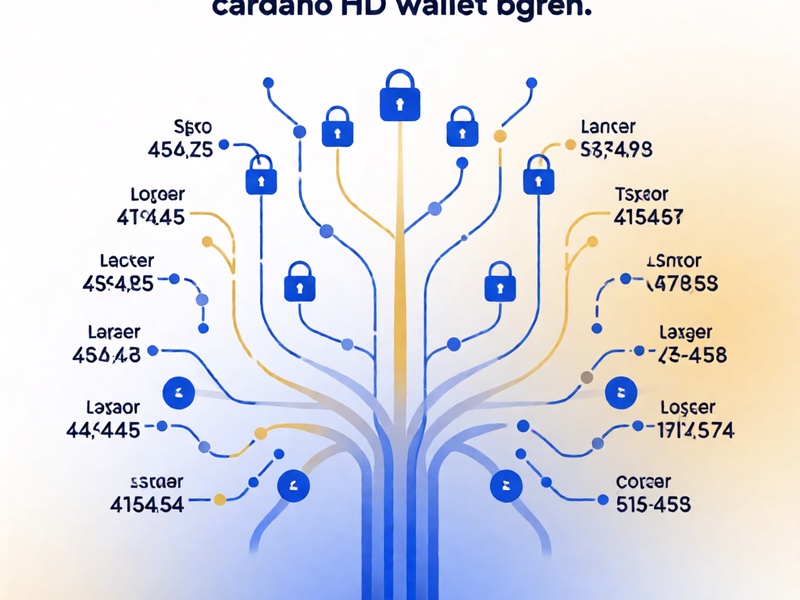
This means the same 12 words may produce different addresses under different wallet configurations. Recovering a Cardano wallet therefore requires more than matching words: the correct derivation path, wallet software, and optional passphrase must also align. That extra context makes blind inference even less realistic.
The Real-World Security Implications
For legitimate users, the practical lesson is simple: your 12-word phrase is the wallet. Anyone who has it can restore access. Do not type it into websites, chat apps, cloud notes, or screenshots. Store it offline, ideally on durable media or a metal backup, and keep multiple secure copies in separate locations. If you use a hardware wallet, verify that the recovery phrase displayed by the device matches your backup.
If you are trying to recover your own wallet, use only official or reputable wallet software and work offline where possible. If words are missing, recovery may depend on how many are missing and whether their positions are known. One or two missing words in a known position can sometimes be handled with careful, legitimate recovery tools, but the complexity grows extremely quickly. Never use a recovery service that asks for your full seed phrase.

Common Myths and Mistakes
- Myth: A 12-word phrase is weak because 12 is a small number. Reality: 128-bit entropy is enormous.
- Myth: If a phrase passes checksum, it must be correct. Reality: Checksum only validates format.
- Myth: The order of words does not matter. Reality: Order changes the derived keys.
- Myth: All Cardano wallets use the same derivation. Reality: Byron and Shelley wallets differ.
- Myth: Online seed phrase checkers are safe. Reality: They are a common phishing tactic.
Conclusion
Cardano 12-word mnemonic security is not based on hiding a simple pattern. It is based on cryptographic entropy, a checksum that filters invalid phrases, and deterministic key derivation that produces a vast tree of addresses. Reasoning about combinations can help users understand why the system is secure, but it cannot make brute-force inference practical. The best strategy is not to guess a mnemonic, but to protect your own with disciplined offline backup and never share it with anyone.