Losing a wallet backup can feel like losing money. For beginners, the stress is worse because terms such as BIP38 and mnemonic are often mixed together. In most real cases, recovery is not impossible, but the correct first step is to identify exactly what was lost: a BIP39 recovery phrase, a BIP38 encrypted private key, a wallet password, a derivation path, or all of them.
First, clarify the difference between BIP38 and mnemonic
BIP38 is a password encryption scheme for a single Bitcoin private key. It does not create a mnemonic phrase. BIP39 is the common mnemonic standard, usually a 12, 15, 18, 21, or 24 word recovery phrase. Many people say they lost their BIP38 mnemonic when they actually mean one of these:
- A BIP39 recovery phrase used by a wallet that also supports BIP38 private key encryption.
- A BIP38 encrypted private key, such as a string starting with 6P, plus its password.
- A wallet seed that was encrypted, stored on paper, or imported into an app.
The difference matters because a BIP39 phrase can restore many addresses, while a BIP38 encrypted key only protects one private key.
Stop panic actions and protect what remains
If the wallet is still open on a device, do not close it yet. If you can export a private key, recovery phrase, or keystore, make a backup first. If you believe the backup was stolen, create a new wallet on a clean device and move only what you can safely access. Never paste your mnemonic or encrypted private key into a website, browser extension, email, or chat. There is no official central recovery service for self-custody crypto.
Step-by-step recovery checklist
1. Search every backup location
Check metal plates, paper wallets, photo backups, password managers, encrypted cloud storage, old notes, email attachments, wallet app folders, and hardware wallet setup screens. A lost mnemonic is often recoverable only if the full phrase or its fragments were backed up. If you used an auto-created wallet, only the official app export path should be used if the app remains unlocked. Do not use third-party memory-extraction tools because they can expose private data.
2. Verify whether you have a BIP39 mnemonic
A BIP39 phrase usually has all words in the correct order. If words were shuffled, check the original order from screenshots or written notes. If only some words are missing, the checksum can eliminate many invalid combinations, but it cannot magically reconstruct a completely missing phrase. If exactly one word and one position are missing, offline BIP39 checksum validation is usually manageable. If the position is unknown, try each position. If two or more words are missing, calculate the search space before acting, because the effort can rise rapidly and may be impractical. Use offline air-gapped tools only if you understand the risks, and never submit candidate seeds to online validators.
3. Check for a BIP38 encrypted private key
If your lost backup is a BIP38 encrypted key, look for a long string starting with 6P. To recover funds, you normally need both the encrypted key and its password. If the password is known, decrypt the key using a trusted open-source tool, import the private key into a wallet, and create a proper backup. If the encrypted key is present but the password is unknown, you may try an offline dictionary or brute-force attack on a copy, but success depends heavily on password strength and available computing time. If the encrypted key itself is lost, decryption is impossible because the private key cannot be reconstructed from the address alone.
4. Confirm the derivation path and wallet type
A recovery phrase can generate different addresses depending on derivation path, account number, or a BIP39 passphrase. If you think the mnemonic is lost but the wallet still recognizes funds, the real issue may be the path. Try the default paths used by major wallet families while the app remains unlocked, but do not expose the seed. If you used a passphrase, remember that it is part of the seed. Forgetting a passphrase is equivalent to forgetting the mnemonic, unless the encrypted wallet file itself is recovered and its password remains available.
5. Look for related files and services
Some wallets store encrypted backups in the app data folder. Some users saved a keystore file with a password. If you used a custodial service, contact the provider immediately. If you used multisig, check whether other signing devices or co-signer backups still exist. Multisig can change the recovery outlook, because one lost seed may not mean total loss when required threshold signatures remain available from other parties.
What cannot be recovered
If you have only a public address and no private key, seed, encrypted private key, keystore, or service account, the funds are not recoverable by ordinary means. Cryptography is designed so that public data cannot reveal private data. Be cautious of people who promise private key retrieval, address cracking, or mnemonic reconstruction for a fee. Most such offers are scams, and many will ask you to upload partial backups before disappearing.
When a partial loss is survivable
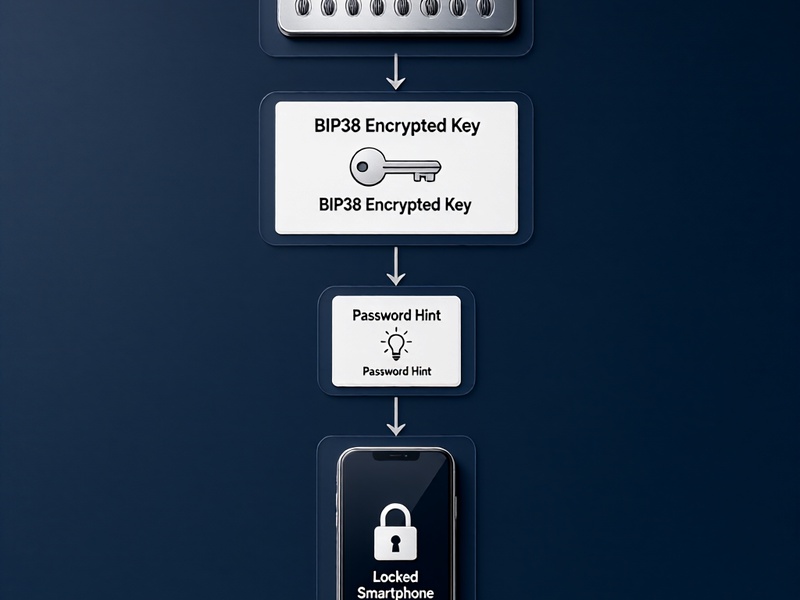
You may recover if:
- You still have access to the unlocked wallet and can export the seed or private keys.
- You have a BIP38 encrypted key plus its password.
- You have a keystore file plus its password.
- You have a multisig setup with enough participating keys.
- You have a custodial account and can verify your identity.
- You have fragments of the mnemonic and know the total word count or some words.
You likely cannot recover if:
- Only the address remains.
- The BIP38 encrypted private key is lost.
- The BIP39 mnemonic is completely lost with no backup and no accessible backup inside the original unlocked wallet.
- A passphrase was forgotten and no original encrypted backup file remains.
If the loss is from theft or compromise
If a third party saw the mnemonic or encrypted key, assume the funds are already at risk. Move accessible funds to a new wallet created with a fresh seed on a clean device. Change all associated email and cloud passwords, enable strong authentication, and check whether other wallets were imported into the compromised app. Do not reuse the old backup, and do not believe that deleting a device screenshot removes a leak if someone else may have copied it.
Build a beginner-proof backup plan
After recovery or when creating a new wallet, follow these practices:
- Back up the BIP39 mnemonic on paper or metal, not only in photos.
- Store backups in at least two safe locations that are not both vulnerable to fire, flood, or theft.
- Use a BIP39 passphrase only if you have a separate backup plan for it.
- For single keys, encrypt them with BIP38, then store both the encrypted key and password offline, separated logically so one breach does not expose both.
- Test recovery on a small amount first.
- Record the derivation path and wallet type.
- Keep a written note of which addresses belong to which seed.
- Avoid cloud syncing unless the backup is encrypted with a strong password and you understand the risk.
- If you still hold funds behind a BIP38 encrypted key, consider moving them into a new BIP39 HD wallet and back up the new seed in multiple secure forms.
Practical first actions
- Write down exactly what you still have: full phrase, partial words, encrypted key, password hint, app name, date, device, and address.
- Do not reset, reinstall, or log out of the unlocked wallet until you export data.
- Search all offline and online backups.
- If a BIP38 encrypted key is found, decrypt it only with trusted offline software.
- If the seed is partially missing, validate candidate orders offline and understand realistic time limits.
- If nothing remains, stop searching for miracle recovery services and shift focus to securing future funds.
Summary
For beginners, losing a BIP38 mnemonic usually means losing access to a wallet backup that may be a BIP39 phrase, a BIP38 encrypted private key, or both. The most important step is to identify the exact asset type and check whether any usable backup, unlocked app, encrypted file, or multisig key remains. A BIP38 key can be decrypted if the encrypted key and password exist. A BIP39 phrase can restore wallets only if the words, order, optional passphrase, and derivation path are known or recoverable. If only a public address is left, recovery is generally impossible. The best protection is calm verification, secure offline backup testing, and strong prevention for future wallet creation.