Cryptocurrency wallets store access to funds through a deterministic seed phrase. Exodus, a popular multi-chain desktop and mobile wallet, depends on that backup mechanism, and users often wonder how intelligent input validation can reduce typos without weakening security. Fuzzy matching of recovery phrases is one such technique: it helps a wallet interface recognize near-correct mnemonic words while still demanding cryptographic proof that the entire phrase is valid.
How Exodus Handles Recovery Phrases
A recovery phrase is a human-readable representation of wallet entropy. Most modern wallets, including Exodus-style seed backups, align with BIP39, which maps cryptographic randomness to words from a fixed 2048-word list. The phrase usually contains 12, 15, 18, 21, or 24 words, depending on the wallet setup. Each word encodes 11 bits of data, while the final word includes checksum bits that help detect invalid backups.
Exact matching matters because any changed word produces a different private key path. A typo such as a swapped letter or a missing vowel is not a harmless spelling variation; it changes the wallet. Yet ordinary users often mistype words on mobile keyboards, especially during recovery when stress and time pressure are high. That gap between cryptographic strictness and human input quality is where fuzzy matching can add value.
What Fuzzy Matching Means in a Wallet Context
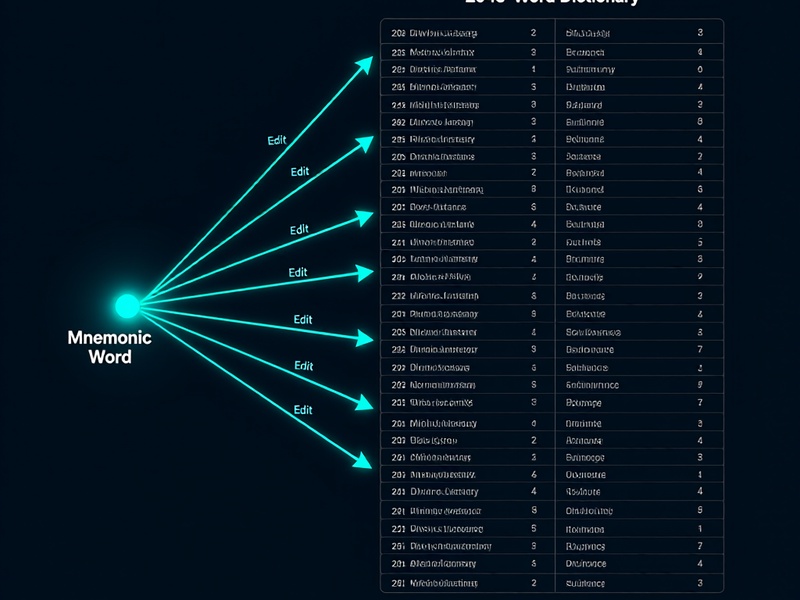
Fuzzy matching compares a user-entered token with a known vocabulary instead of rejecting it at the first mismatch. In a recovery phrase field, the vocabulary is the BIP39 wordlist. The system may calculate similarity using edit distance, character bigrams or trigrams, prefix overlap, or phonetic patterns. A word such as acount can be suggested as account, while a near miss such as recieve can be mapped toward receive if the dictionary supports the target word.
The important distinction is between suggestion and acceptance. Fuzzy matching can say, The entered word is close to account; would you like to replace it? It cannot say, The wallet is now restored because the words are similar enough. The final state must be produced only after full cryptographic validation.

Technical Workflow of Secure Fuzzy Matching
A well-designed Exodus-style fuzzy recovery input usually follows these steps.
- Tokenize the entered phrase into separate words and normalize simple variations such as leading or trailing spaces and common punctuation artifacts.
- For each token, search the BIP39 wordlist and retrieve candidates using Levenshtein or Damerau-Levenshtein distance. Damerau variants are useful because they recognize swaps, which are common on touch keyboards.
- Rank candidates by a combined score. The score may include edit distance, n-gram overlap, first-letter consistency, and word frequency in existing backups.
- Require the user to confirm any replacement. Automatic correction should be rare and visible because a seed phrase is a security boundary.
- Validate the complete 12, 15, 18, 21, or 24-word phrase against the BIP39 checksum before deriving keys or showing wallet balances.
- Keep all matching logic local. If suggestions are generated on a server, partial seed information may leak and user trust can be damaged.
Why the Final Check Must Remain Strict
Fuzzy matching improves usability, but cryptographic correctness cannot be negotiated. The BIP39 checksum protects against simple mistakes, yet it is not a proof of recovery. After the words are finalized, the wallet must hash the mnemonic, apply PBKDF2 with any optional passphrase, derive the master key, and generate the expected wallet addresses. If that process produces the same public keys and transaction history as the known wallet, the phrase is likely valid. If it does not, the wallet must refuse access regardless of how close each word looked.
This strictness also explains why fuzzy matching cannot rescue a badly forgotten phrase. If many words are missing or if the passphrase is wrong, similarity scoring only increases the risk of false hope. The correct response is clear guidance: stop guessing, check backups, and treat recovery as a controlled security process.
Security Risks and Privacy Considerations
Fuzzy matching becomes dangerous when it is implemented as a hint engine for attackers or as a cloud service. A secure wallet design should observe these constraints.
- Never transmit partial recovery phrases to a remote server for suggestion purposes.
- Rate-limit and isolate input attempts so the app does not expose many guesses to a compromised device.
- Make suggestions transparent and reversible. Users need to see what changed before accepting a word replacement.
- Avoid autocomplete that silently edits phrases during paste or import.

- Protect memory by wiping intermediate candidate lists from logs and crash dumps.
- Document clearly that support staff cannot validate a recovery phrase on behalf of the user.
Practical Guidance for Exodus Users
The strongest habit is still exactness. Store the backup phrase in a physical, offline location, preferably in a metal or fire-resistant seed backup if the holdings justify it. When restoring, enter the words slowly, verify spelling, and disable browser or system autocomplete if it can interfere. If the app offers fuzzy suggestions, use them only as an aid for obvious typos, not as a way to reconstruct unknown words.
If the phrase was created with a passphrase, remember that both parts are necessary. A correct 12-word seed with the wrong passphrase opens an empty wallet, while a fuzzy-corrected word set with the correct passphrase still fails if any entropy is wrong. For large balances, consider creating a fresh wallet and moving assets to a clean backup rather than struggling with an ambiguous recovery session.
Conclusion
Exodus recovery phrase fuzzy matching is a useful intersection of human-centered design and cryptographic discipline. It can reduce frustration caused by keyboard mistakes and make backups more accessible, but it must never dilute the requirement for an exact, checksum-validated seed phrase. When the matching layer is local, transparent, and constrained, it improves usability while preserving the one principle that matters most in self-custody: keys are controlled only by the correct recovery data, not by approximate input.