Introduction
BIP38 (Bitcoin Improvement Proposal 38) remains one of the most robust access control mechanisms for crypto self-custody, encrypting raw private keys with a user-selected strong passphrase so that even if a key file is exposed, bad actors cannot move funds without the associated password. Yet on-chain data from Chainalysis shows that roughly 20% of circulating Bitcoin is permanently lost, and a significant share of these losses stem from flawed backup workflows for BIP38-protected assets: users often assume encryption eliminates risk of total loss, only to discover corrupted backups, misplaced passphrases, or unreadable key strings when they attempt to recover funds. This guide outlines a validation-first, layered backup framework tailored explicitly for BIP38 assets to eliminate preventable loss without eroding the security benefits of BIP38 encryption.
Common BIP38 Backup Failure Points That Lead to Permanent Loss
Before building a reliable backup system, it is critical to address the most frequent failure modes that render BIP38 assets unrecoverable:
- Unvalidated backups: Most users generate a BIP38 encrypted key, write the string down immediately, and never test if the backup can actually be decrypted on an offline device. Common transcription errors (e.g., swapping visually similar characters, missing a checksum digit) can make a backup completely unreadable, even if the user remembers the correct passphrase.
- Single-point storage risk: Storing a full BIP38 backup in only one location exposes assets to total loss from physical damage (fire, flood, water damage to paper backups), theft, or accidental deletion (for digital backups).
- Conflated key and passphrase storage: Many users store their BIP38 encrypted key string alongside the decryption passphrase in the same location, defeating the purpose of BIP38 encryption and creating a single point of failure. Others rely exclusively on memory for their passphrase, which can lead to total loss if the user experiences cognitive impairment, injury, or unexpected death.
- Non-standard key formatting: Amateur edits to BIP38 key strings (e.g., adding handwritten annotations that overwrite checksum characters, trimming whitespace incorrectly) can break compatibility with standard BIP38 recovery tools, making backups unrecoverable even with correct passphrases.
Layered, Validation-First BIP38 Backup Architecture
The below framework is designed to ensure 100% recoverability while maintaining BIP38’s core security guarantee that no single exposed backup can be used to steal funds.
Step 1: Generate and Verify the BIP38 Key Before Any Backup Activity
All BIP38 key generation must happen on an air-gapped, offline cold wallet device with no network connectivity to eliminate interception risks. Immediately after generating the key:
- Transcribe the full BIP38 string exactly as printed, without edits, to a temporary paper copy.
- Test decryption on a second separate offline device using a reference BIP38 tool (e.g., the open-source Bitcoin Core BIP38 implementation, the offline build of the BIP38 utility) to confirm that the key string and user-selected passphrase correctly resolve to the expected on-chain address.
- Only move to formal backup creation once this test passes: if decryption fails, discard the temporary copy and re-generate a new key.
Step 2: Split the Encrypted BIP38 Key String Using 2-of-3 Shamir’s Secret Sharing
Never store the full BIP38 key string in a single location. Instead, use an offline, open-source Shamir’s Secret Sharing (SSS) tool to split the verified BIP38 string into 3 equally sized fragments, such that any 2 fragments are required to reconstruct the full encrypted key. Store the three fragments in geographically separate, secure locations:
- Fragment 1: Sealed, water- and fire-resistant backup sleeve in a home floor safe.
- Fragment 2: Identically sealed sleeve in a rented bank safety deposit box.
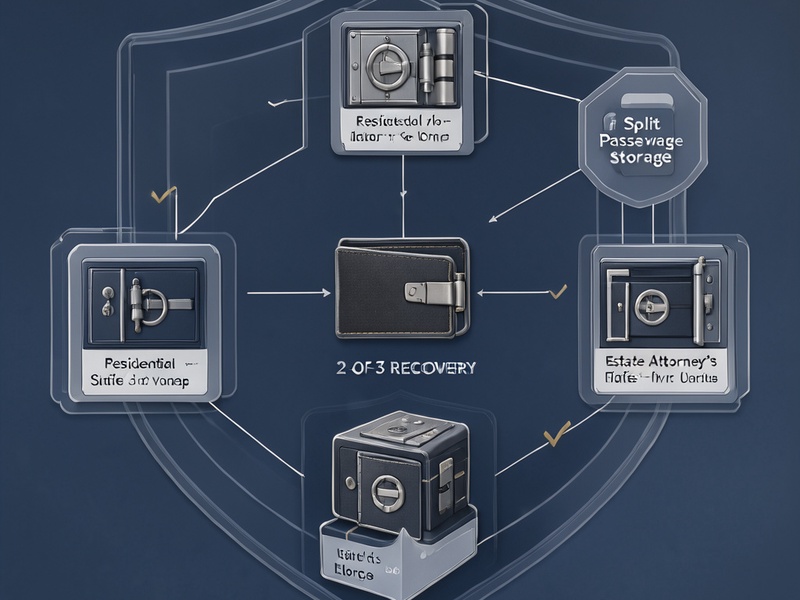
- Fragment 3: Sealed, labeled envelope held by a trusted, legally documented next of kin or estate attorney.
Because the BIP38 string remains encrypted, no single exposed fragment is actionable: even if one fragment is stolen, the thief cannot reconstruct the full key, nor can they decrypt it without the separate passphrase.
Step 3: Decouple and Securely Store the BIP38 Decryption Passphrase
The passphrase used to encrypt the BIP38 key must never be stored in the same location as any key fragment. Use a split storage model for the passphrase:
- Keep 50% of the passphrase as an exclusively memorized string, never written down.
- Store the remaining 50% of the passphrase in a sealed, tamper-evident envelope held in a separate location from the three key fragments (e.g., held by the same estate attorney, stored in a secondary home safe).
This model ensures that a trusted party can support recovery in the event the key holder cannot access their memory, but no single party or location can reconstruct both the full key and full passphrase to steal funds.
Step 4: Schedule Regular Backup Integrity Checks
Every 6 months, run a full end-to-end recovery test on an offline device:
- Retrieve two of the three key fragments and the two parts of the passphrase.

- Reconstruct the full BIP38 key, decrypt it, and confirm that it resolves to the correct on-chain address.
- Inspect all stored fragments for physical damage, fading, or tampering, and replace any degraded backups as needed.
These checks catch issues like faded ink on paper backups, bank safe accessibility changes, or damaged storage sleeves long before an actual recovery emergency.
Critical Misconceptions to Avoid
Even with a strong workflow, users often fall prey to common myths that undermine backup security:
- Myth 1: BIP38 encryption makes backups immune to loss. Encryption blocks unauthorized access, but it does not protect against corrupted, incorrectly transcribed, or damaged key strings. A single missing character renders even the strongest encryption useless for recovery.
- Myth 2: Cloud storage is a safe backup location for BIP38 keys. Cloud drives are subject to service provider policy changes, account lockouts, and data breaches. While a BIP38 encrypted string on a cloud drive is not immediately exploitable, storing it online creates an unnecessary exposure risk that can be eliminated with offline storage.
- Myth 3: A single paper backup is sufficient. Paper is vulnerable to fire, flood, accidental destruction, and theft. Redundancy across separate locations is non-negotiable for assets holding meaningful value.
Final Takeaway
BIP38 encryption delivers unmatched protection against unauthorized key access, but its security value is entirely dependent on a rigorous, tested backup process. By building a layered system that prioritizes validation, geographic redundancy, and decoupled key and passphrase storage, users can eliminate nearly all preventable risk of permanent BIP38 asset loss, without sacrificing the privacy and security benefits that make BIP38 a popular choice for long-term crypto self-custody.