Hardware wallets such as ColdLar are built around a simple promise: your private keys should stay offline, while your recovery method should remain human-readable. The BIP39 standard is the bridge between those two goals. It turns cryptographic randomness into a short list of words that can rebuild a wallet on a compatible device. Understanding the principles behind BIP39 helps you use a ColdLar wallet with more confidence and fewer mistakes.
What BIP39 Solves
BIP39, short for Bitcoin Improvement Proposal 39, defines how to create a mnemonic code for generating deterministic keys. Before BIP39, backing up a wallet could mean saving complex binary or hexadecimal data. That was error-prone and difficult for humans to verify. BIP39 replaced raw entropy with a standard wordlist, usually 12, 15, 18, 21, or 24 words.
For a ColdLar wallet, this means the recovery phrase is not just a random password. It is a standards-based representation of the entropy that produces the wallet seed. As long as another wallet follows BIP39 and uses the same derivation rules, the same words can recover the same accounts.
From Entropy to Words: The Core Steps
BIP39 mnemonic generation follows a precise sequence:
- Generate entropy. The wallet creates random data with a defined size: 128, 160, 192, 224, or 256 bits.
- Add a checksum. The wallet hashes the entropy with SHA-256 and appends the first ENT / 32 bits as a checksum.
- Split into 11-bit groups. Each group represents a number between 0 and 2047.
- Map numbers to words. Each number selects one word from the official BIP39 wordlist of 2048 words.
- Produce the mnemonic. The total number of words becomes 12, 15, 18, 21, or 24.
A 128-bit entropy value produces a 4-bit checksum and 12 words. A 256-bit entropy value produces an 8-bit checksum and 24 words. More entropy means more words, but all standard lengths are designed to be migration-friendly across BIP39 wallets.
Why the Wordlist Has 2048 Words
The BIP39 wordlist is not arbitrary. Each word corresponds to an 11-bit index. Since 2^11 equals 2048, the list has exactly 2048 entries. The words are chosen to be distinct and reasonably easy to distinguish. In the English list, each word is unique within its first four letters, which reduces confusion when users write or enter a phrase manually.
This design matters for ColdLar users because recovery is often a manual process. A wordlist with clear differentiation lowers the chance of transcription errors. It also makes checksum validation more useful when the phrase is restored.
The Mnemonic Is Not the Final Seed
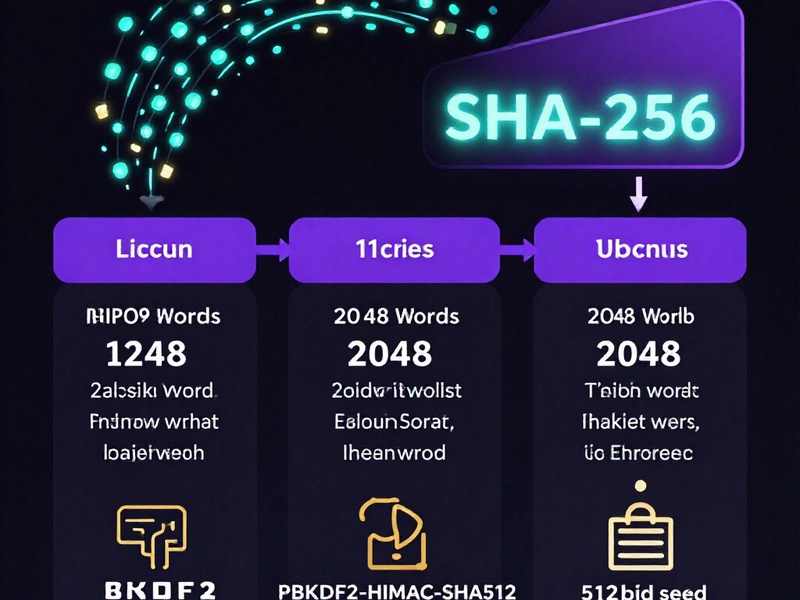
A common misunderstanding is that the 12 or 24 words are the private key. They are not. The mnemonic is an encoded backup of entropy. To create the actual wallet seed, BIP39 uses PBKDF2-HMAC-SHA512.
The process works like this:
- The mnemonic sentence is normalized and used as the password input.
- The salt is the string mnemonic plus an optional passphrase.
- PBKDF2 runs for 2048 iterations.
- The output is a 512-bit seed.
That 512-bit seed becomes the root for hierarchical deterministic key derivation, usually through BIP32. Account structure and address types are then defined by standards such as BIP44, BIP49, or BIP84. In a ColdLar wallet, these derivation steps happen inside the secure environment, so the mnemonic and derived private keys do not need to touch an internet-connected computer.
Optional Passphrase: Powerful but Unforgiving
BIP39 supports an optional passphrase, sometimes called the 25th word. It is not part of the mnemonic list and is not stored by the wallet. It changes the PBKDF2 salt, which means the same 12 or 24 words can produce a completely different wallet seed.
This feature offers plausible deniability and extra separation. It also creates a dangerous single point of failure. If you forget the passphrase, there is no checksum or recovery service that can restore it. If you lose the passphrase, you lose access to the wallet derived with it. ColdLar users should only use a BIP39 passphrase if they fully understand the backup implications and store it separately and securely.
What the Checksum Does and Does Not Do
The checksum is a validation tool. When you restore a mnemonic, a BIP39-compatible wallet recalculates the checksum from the words. If the checksum does not match, the wallet rejects the phrase. This catches many typos, missing words, and ordering mistakes.
However, the checksum is not encryption. It does not protect the phrase from theft. It also does not guarantee that a phrase was generated securely. A checksum-valid mnemonic can still be weak if it came from a compromised random number generator. This is why generating the phrase on a trusted hardware wallet such as ColdLar, rather than on a website or phone app, is essential.
How ColdLar Wallet Applies These Principles
A ColdLar hardware wallet uses BIP39 principles to support secure self-custody:
- Offline generation. The recovery phrase should be created inside the device, using its random number generator and secure firmware.
- Secure storage. The seed is encrypted and protected by the device PIN or secure element, depending on the model and firmware.
- Isolated signing. Private keys are derived and used inside the hardware wallet, so they are not exposed to the host computer.
- Standard recovery. BIP39 compatibility allows the wallet to be restored on another compatible device if the hardware fails.
- Optional passphrase support. When available, the BIP39 passphrase adds an extra derivation layer that must be backed up separately.
Exact features can vary by ColdLar model and firmware version. Always check the official documentation for your device before relying on a specific recovery workflow.
Security Practices for ColdLar and BIP39 Users
- Generate on the device. Never create a seed phrase with an online generator, browser extension, or screenshot tool.
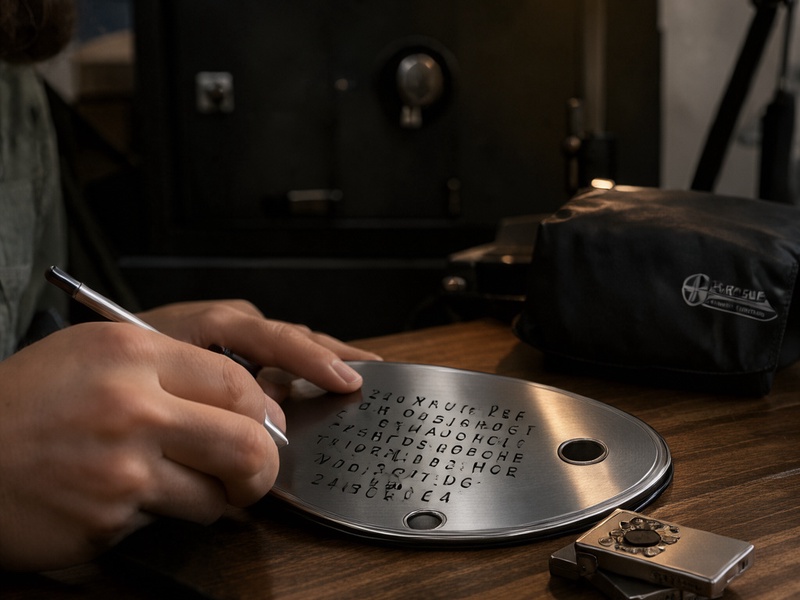
- Write it offline. Use paper or a metal backup plate. Store copies in separate, secure locations.
- Never share the words. No legitimate support agent, wallet app, or giveaway needs your mnemonic.
- Verify word order. The checksum catches some mistakes, but order is part of the entropy.
- Understand the passphrase. If you use one, back it up as carefully as the mnemonic, but never store them together.
- Test recovery safely. Before moving large funds, verify that your backup can restore a small test wallet.
- Use official firmware. Download updates only from the official ColdLar source and verify checksums when possible.
- Treat photos as leaks. A photo of your mnemonic in cloud storage or a messaging app can expose the wallet.
Common Misconceptions
- More words always means more security? 24 words represent 256 bits of entropy, which is extremely strong, but 12 words with 128 bits is still robust when generated correctly.
- BIP39 encrypts the wallet? No. BIP39 standardizes mnemonic encoding and seed derivation. Encryption and secure storage are separate concerns.
- The wallet brand locks the seed? A standard BIP39 mnemonic is portable. The same words can often be restored in other compatible wallets.
- A passphrase is just a PIN? No. A PIN unlocks a device. A BIP39 passphrase changes the derived wallet itself.
Conclusion
ColdLar wallet security rests on well-established standards, and BIP39 is one of the most important. It converts entropy into a checksummed list of words, then uses PBKDF2-HMAC-SHA512 to derive a seed for hierarchical deterministic wallets. The result is a recovery method that is portable, human-readable, and compatible with much of the crypto ecosystem.
The words are simple. The principles behind them are not. By understanding entropy, checksums, seed derivation, and passphrase risks, ColdLar users can protect their recovery phrase with the seriousness it deserves. In self-custody, the mnemonic is not just a backup. It is the wallet.