Scope and legal boundaries
This Dogecoin密码HashCat使用指南 is intended only for lawful recovery of a Dogecoin wallet you own or are explicitly authorized to audit. Hashcat is a password-auditing tool; using it against wallets or systems without permission may violate law and trust. Work on copies, keep backups offline, and document authorization.
What Hashcat does in a Dogecoin recovery workflow
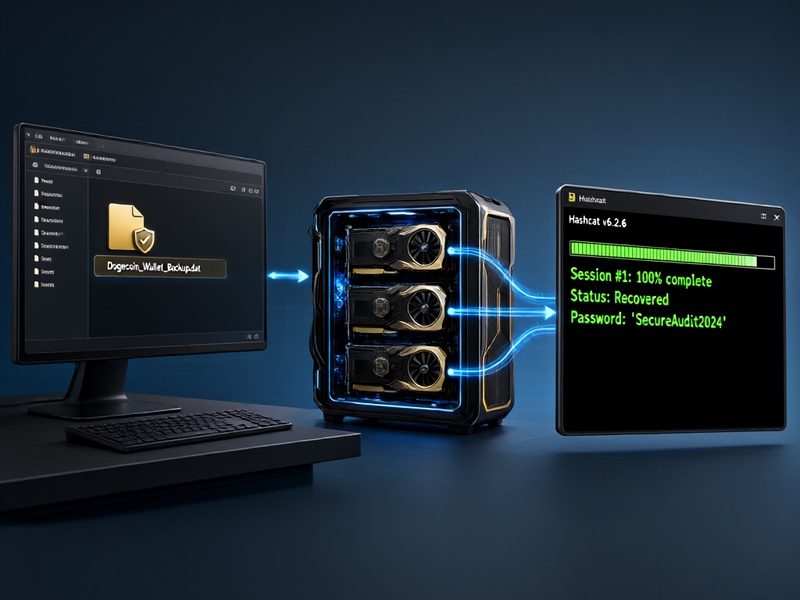
Hashcat is a high-performance password recovery and auditing tool that tests candidate passphrases against a hash representation of an encrypted wallet. It does not magically decrypt a wallet file; it attempts to find the passphrase that unlocks it. For Dogecoin Core-style wallets, the relevant format is usually tied to the wallet encryption scheme, so confirm the exact mode in Hashcat’s official example-hash documentation before running anything. Never guess a mode on a production wallet.
Preparation checklist
- Confirm ownership and legal authorization.
- Back up the original wallet.dat and store it offline; work only on a copy.
- Record wallet client version, encryption settings, and any remembered password patterns.
- Use an isolated, offline machine with updated GPU drivers and a trusted Hashcat build.
- Protect extracted hash files and wordlists with disk encryption and restricted access.
- Prepare a verification plan: open the recovered wallet copy in an offline client before moving funds.
Recovering and validating the hash
Use only a trusted, wallet-specific extraction utility that matches your wallet version. Verify that the extracted hash matches Hashcat’s documented format and mode. If the format is unsupported or ambiguous, stop and seek expert help instead of forcing a mode. Keep original evidence and hash copies separate, and record checksums for auditability.
Choosing a practical attack strategy
Start with targeted recovery, not brute force:
- Use a curated wordlist based on passphrase patterns you legitimately remember.
- Try rule-based mutations for capitalization, years, symbols, and common substitutions.
- Use masks only for short, structured passwords you plausibly used.
- Benchmark the selected mode first to estimate speed and power draw.

- Run short sessions, save progress, and review the potfile before broadening the search.
Generic Hashcat workflow examples use placeholders only:
hashcat --benchmarkto check device performance.hashcat -m <wallet-mode> -a 0 hash.txt wordlist.txtfor dictionary auditing.hashcat -m <wallet-mode> hash.txt --showto review recovered candidates.
Replace placeholders only after verifying the supported mode and legal scope.
Performance and safety tuning
Hashcat performance depends on GPU, driver, cooling, and mode complexity. Monitor temperatures and power limits, avoid overclocking unstable systems, and use session restore for long runs. Do not run recovery on a machine that stores unrelated sensitive data. Prefer an offline environment and disable network access during recovery unless you need updates.

Common problems and fixes
- Wrong mode: re-check the wallet format against official documentation.
- Driver errors: install vendor GPU drivers and verify OpenCL/CUDA support.
- Slow recovery: benchmark, reduce rule complexity, or use targeted masks.
- False confidence: always validate the recovered passphrase on a copy before moving funds.
- No result: revisit remembered patterns, verify hash extraction, and consider professional recovery services.
After recovery
Immediately create a new encrypted backup, migrate funds to a freshly secured wallet if compromise is possible, and store the new passphrase in a password manager. Document the audit, delete unnecessary hash copies, and harden the machine used for recovery. This Dogecoin密码HashCat使用指南 should end with better security than it started with.
Conclusion
Hashcat can be a useful part of authorized Dogecoin wallet recovery and security auditing when used with care, verified modes, and strict legal boundaries. Focus on targeted recovery, protect wallet backups, validate results offline, and never use these techniques on wallets you do not own or have explicit permission to audit.