Introduction
Ethereum wallet recovery is not a password reset. It is the process of regaining control over account keys, key material, or on-chain recovery state. The technical path differs depending on whether the wallet is an externally owned account restored from a mnemonic, a keystore file decrypted by password, a hardware wallet, or a smart-contract wallet using account abstraction or social recovery. This article explains the cryptographic layers, derivation standards, software behaviors, and operational details that determine whether a wallet can be safely and correctly recovered.
What an Ethereum Wallet Actually Controls
For an externally owned account, the wallet controls a private key. That private key is a 256-bit integer. The public key is derived by elliptic-curve multiplication over secp256k1. The Ethereum address is the last 20 bytes of the Keccak-256 hash of the uncompressed public key. Displayed addresses may use EIP-55 mixed-case checksums, but the underlying address bytes remain the same.
There is no cryptographic recovery service for a lost private key or lost seed phrase unless the original backup is restored, a multi-signature owner set can re-establish control, or the account is governed by a recovery module in a smart-contract wallet. In other words, recovery is either deterministic from existing backup material or impossible from first principles.
BIP-39, Entropy, and Seed Phrases
Most Ethereum wallets use hierarchical deterministic key structures. A BIP-39 mnemonic encodes entropy plus a checksum. A 12-word phrase typically represents 128 bits of entropy, while a 24-word phrase represents 256 bits. The entropy bits are padded with a checksum, then split into 11-bit groups mapped to words from the BIP-39 wordlist.
The mnemonic itself is not the private key. The wallet first converts the mnemonic into a root seed using PBKDF2-HMAC-SHA512. If a passphrase is present, it participates in this derivation as part of the salt. This means two wallets using the same 24-word phrase but different hidden passphrases will produce different root seeds, different child keys, and different addresses.
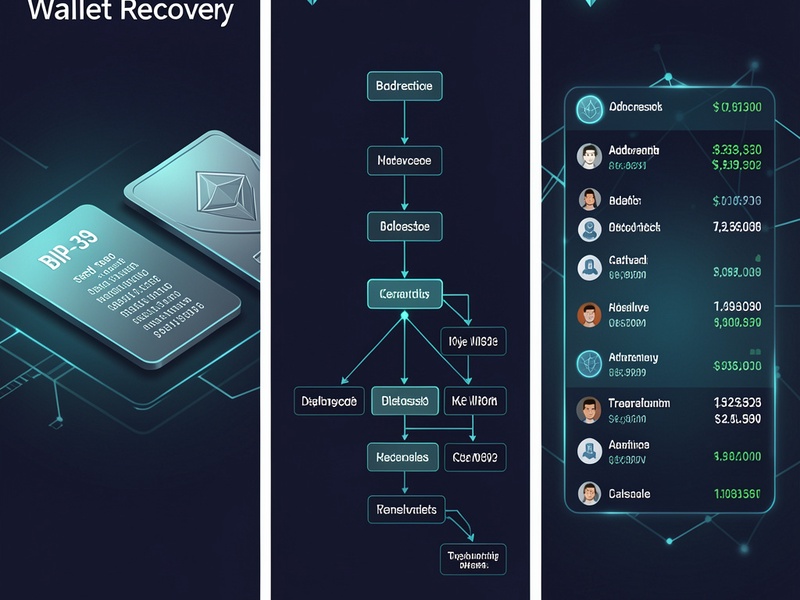
From the root seed, BIP-32 derives extended keys. Ethereum accounts usually use BIP-44 derivation paths such as m/44'/60'/0'/0/0. The hardened path segment 60' denotes Ethereum. The final index controls which account is generated. Different software or hardware devices may use other conventions, which is why an old wallet can sometimes appear empty even when the mnemonic was correct.
Hardware Wallet Recovery Details
Hardware wallets are useful because they separate key custody from the signing host. During recovery, the device may import a mnemonic into its secure element or trusted execution environment, then derive keys internally. The user is never asked to enter the full private key. The public keys are exported to the wallet client, while signing remains device-bound.
A common technical failure is derivation-path mismatch. Ledger devices, for example, have historically had legacy paths and standard paths. If the user expects Ledger Live addresses but selects a legacy path, or vice versa, the wallet client may derive a different account sequence. Proper recovery requires trying the expected path, known legacy paths, and adjacent account indexes, while comparing balances, transaction counts, and nonce values through Ethereum RPC or block explorer APIs.
Keystore Files and Password-Based Decryption
Keystore wallets follow the Web3 Secret Storage Definition. A private key is encrypted under a password using key derivation functions such as scrypt or Argon2. The encrypted payload includes salt, parameters, ciphertext, and a MAC. Decryption succeeds only when the password produces the expected MAC. There is no server-side password recovery and no way to skip the KDF without a plausible password candidate.
Recovering from a keystore requires both the JSON file and the correct password. Brute-forcing a strong password is impractical because the KDF deliberately consumes CPU or memory. If the password is forgotten but a mnemonic exists, the mnemonic is usually the better backup artifact. If only the keystore remains, the only recovery is password reconstruction.
Smart-Contract Wallet Recovery and Account Abstraction
Smart-contract wallets change the technical model. The account is no longer defined only by a private key; it is defined by contract state. Recovery can be built into the contract logic through owner modules, guardians, session keys, timelocks, or multisig thresholds. In ERC-4337 account abstraction, a factory computes deterministic counterfactual addresses using CREATE2, while recovery transactions are routed through modules and the EntryPoint contract rather than through a single externally owned key.
Safe multisig wallets are a practical example. The Safe contract stores owner addresses and a threshold. Recovering access means collecting enough active owners or using a pre-established recovery path. If a private key for one Safe owner is lost, the Safe itself can still be operated if the remaining owner set meets the threshold. However, if the owner key cannot be rotated before all signers are lost, the contract may become unreachable. Smart-contract recovery therefore shifts the security assumption from one secret to governance and state.
On-Chain Discovery and Wallet Synchronization
Recovery does not end at key derivation. Wallet clients must discover which addresses are active. HD wallet software usually derives a limited number of accounts and uses a gap limit to decide when to stop scanning. If the user sent funds to an address beyond the scanned window, the client may show an empty balance until additional indexes are derived.
The wallet client also queries Ethereum nodes for balances, nonces, token events, and transaction history. Pending transactions, nonce gaps, and chain reorganizations can temporarily affect what the UI displays. During recovery, operators should confirm the correct chain ID, whether the wallet is connected to the right network, and whether local caches need to be re-synced. A balance discrepancy is often not loss of funds but a derivation, indexing, or network configuration issue.
Common Failure Modes
The most frequent recovery failures are technical, not magical. They include entering an incomplete BIP-39 phrase, using the wrong wordlist language, omitting a passphrase, selecting the wrong wallet type, importing an Ethereum private key into a network that uses incompatible address formats, restoring a Smart-Contract wallet as an externally owned account, or scanning only a narrow account range. Another failure mode is relying on screenshots or cloud storage of private keys, which is a security anti-pattern but not a recovery method.
Shamir Secret Sharing can reduce single-device or single-person custody risk. SLIP-39 splits seed material into shares that must meet a threshold for reconstruction. This is especially useful for institutional wallets, family custody, or team-owned multisig setups. However, if the derived path or wallet software is unknown, reconstructed seed material alone may still not locate the active account without manual derivation scanning.
Security Best Practices During Recovery
Recovery should happen in an isolated environment. The seed phrase should never be typed into a website, clipboard, or remote desktop session unless the operator is certain the software is genuine and local. Hardware devices should verify firmware and app versions. Wallet clients should be downloaded from verified sources and checked against public release hashes when possible. After restoring access, it is prudent to create a minimal recovery test: send a small value from the recovered address, confirm the public key signature chain, validate the nonce increment, and only then move larger balances.
For long-term custody, store backups offline. Use redundant BIP-39 or SLIP-39 backups, document derivation paths, record account indexes, and store them separately from the keys themselves. If a hidden passphrase exists, treat it as part of the secret; without it, the mnemonic may be useless.
Conclusion
Ethereum wallet recovery is a layered technical process involving mnemonic entropy, key derivation, device attestation, encrypted storage, account scanning, and, in advanced cases, contract state recovery. The deterministic core is simple: control the private key or its source secret, derive the correct account, and verify the on-chain state. The operational difficulty arises from path mismatches, hidden passphrases, smart-contract ownership models, and synchronization assumptions. Understanding these details turns wallet recovery from guesswork into a reproducible engineering workflow.
| Recovery Case | Technical Object Needed | Typical Validation Step |
| --- | --- | --- |
| BIP-39 wallet | Correct mnemonic and derivation path | Compare public keys and addresses |
| Hidden passphrase | Mnemonic plus passphrase | Test PBKDF2 seed and derived index |
| Keystore file | JSON file and password | Check MAC and decrypt locally |
| Hardware wallet | Device, PIN, or trusted seed backup | Import to device and export public keys |
| Smart-contract wallet | Valid owner set or recovery module | Simulate contract transaction and storage state |
| Token or NFT balance | Correct network and account scan range | Query event logs and token balances |