If your Avalanche wallet recovery phrase has the right words but the wrong order, the phrase may fail BIP39 checksum validation or restore to different addresses. The good news is that recovery can sometimes still be possible with careful, offline work. The bad news is that mnemonic order matters enormously, and any online recovery attempt can expose your seed. This guide explains how to approach an Avalanche mnemonic word-order problem safely, what to check first, and when advanced offline recovery is worth attempting.
Why the Word Order Matters
A BIP39 recovery phrase is not just a list of words. The words encode entropy plus a checksum, and their exact order determines the seed. A single swap changes the resulting seed, the derived private keys, and the Avalanche addresses you see in a wallet.
Avalanche-compatible wallets typically use BIP39 and BIP32-style derivation, but wallets can differ in word count, optional passphrase use, and derivation path. That means a phrase restored in the wrong wallet or with the wrong path may look useless even when the words are correct.
Key facts:
- The last word of a BIP39 phrase contains checksum bits. A random reordering usually fails the checksum.
- For 12 words, a random order has roughly a 1 in 16 chance of passing the checksum.
- For 24 words, a random order has roughly a 1 in 256 chance of passing the checksum.
- Passing the checksum is necessary but not enough. You must also derive the expected Avalanche address.
- If a BIP39 passphrase was used, it is part of the recovery. The words alone will not restore the same wallet.
First: Stop, Secure the Situation, and Do Not Share the Phrase
Before trying anything, treat the phrase as compromised if it has been typed into a website, sent by message, photographed, or stored in cloud notes. The priority is to recover and then move funds to a freshly generated wallet.
Use these safety rules:
- Never enter the phrase into an online recovery site, browser extension, or chat tool.
- Official Avalanche support and legitimate wallet teams will not ask for your recovery phrase.
- Prefer an air-gapped computer for offline validation and derivation.
- Keep the target public address available. You do not need to expose private keys to compare addresses.
- If recovery succeeds, restore in an official or audited wallet and move funds to a new wallet with a new phrase.
Check Simple Ordering Mistakes First
Many wrong-order cases are transcription mistakes, not lost entropy. Before building a brute-force workflow, check common patterns:

- Reverse the entire phrase.
- Swap the first and second halves.
- Recover a 6 by 4 grid or 4 by 6 grid written in columns instead of rows.
- Check whether words were copied line by line from a paper backup.
- Swap adjacent pairs, such as 1 and 2, 3 and 4, and so on.
- Confirm the word count. Do not mix a 12-word phrase with a 24-word phrase.
- Verify spelling against the official BIP39 English wordlist if the wallet used English.
- Check whether an optional BIP39 passphrase was used. A passphrase is not one of the 12 or 24 words.
- Confirm the wallet app and derivation path. An Avalanche-native address and an EVM C-Chain address may use different paths.
Do not sort the words alphabetically, and do not assume the checksum word can simply be moved to the end without validation. The checksum depends on the entire ordered entropy.
Validate BIP39 Checksums Offline
An offline BIP39 tool or a small open-source script can test whether a candidate order is valid. The workflow should be local and network-disconnected.
At a high level:
- Load the correct BIP39 wordlist.
- Build a candidate ordered phrase.
- Validate the BIP39 checksum.
- If valid, convert the phrase to a seed with PBKDF2.
- Apply the correct BIP39 passphrase if one was used.
- Derive Avalanche keys for the relevant path or paths.
- Compare derived public addresses with your known Avalanche address.
Checksum validation is fast compared with full seed derivation, so always filter candidates by checksum first. This dramatically reduces the number of expensive derivations.
Constrained Recovery When All Words Are Known but Out of Order
Do not attempt to test every possible order blindly. For 12 words, 12 factorial is about 479 million orders, and checksum filtering reduces that to roughly 30 million valid candidates. That is still substantial. For 24 words, 24 factorial is astronomically larger, so constraints are essential.

Use memory anchors and structural clues:
- Fix words you are confident about in their correct positions.
- Mark words as unknown position only when necessary.
- Use known first words, middle words, or final words as constraints.
- Test plausible grid layouts and column-reading errors.
- If the final word is uncertain, test all 2048 BIP39 words in the final position rather than permuting it with the rest.
- Keep a candidate log so you do not repeat failed orders.
A safe offline script should accept fixed positions, generate permutations for the remaining words, validate the checksum, derive addresses, and stop when a match is found. Use a verified open-source BIP39 library and review the code before running it. Never paste a real phrase into an unverified script or an online notebook.
Match the Avalanche Wallet and Derivation Path
A valid seed can still appear empty if you derive the wrong address type. Avalanche wallets may use different derivation paths depending on whether you are restoring X-Chain, P-Chain, or C-Chain addresses, and different wallets may follow different conventions.
Common patterns to investigate include:
- Avalanche-native paths often associated with coin type 9000, such as m/44'/9000'/0'/0/0 and related account or change indexes.
- EVM-style C-Chain paths often associated with coin type 60, such as m/44'/60'/0'/0/0, depending on the wallet.
These examples are not universal. Confirm the path used by the original wallet. Also test the optional BIP39 passphrase, because a wrong passphrase produces a valid but different wallet.
Use the Right Tools for the Right Job
Tool choice matters:
- A BIP39 library or audited offline script is appropriate for checksum validation, seed derivation, and address comparison.
- btcrecover has seed-recovery features for some wallet formats, but it is not a universal Avalanche mnemonic-order tool. Check support before relying on it.
- HashCat is mainly for password cracking, not for reordering BIP39 words.
- Pywallet is associated with legacy Bitcoin wallet files, not Avalanche mnemonic recovery.
If you use an advanced tool, run it offline, verify its source, and test it with a dummy phrase first. A recovery tool that asks for internet access or uploads your phrase is not suitable for seed recovery.
A Safer Advanced Recovery Workflow
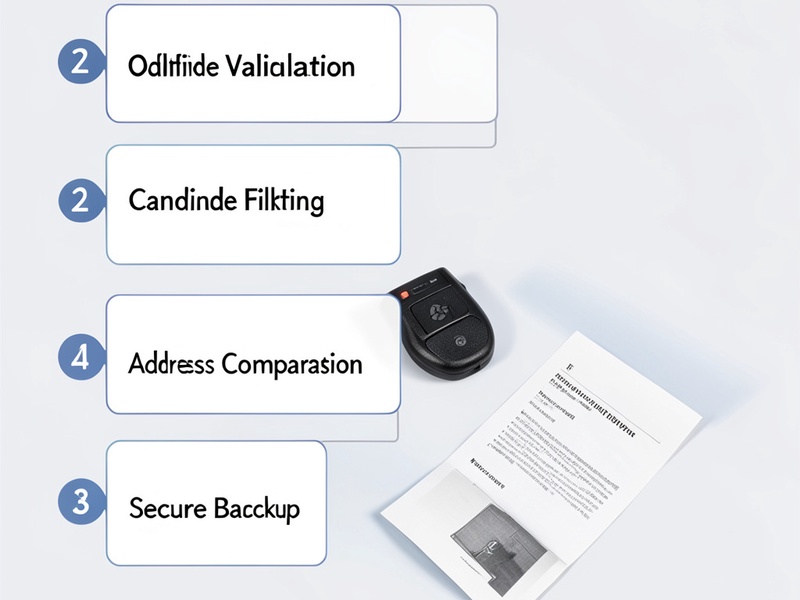
Use this checklist for any serious attempt:
- Work on an air-gapped machine or a live system with networking disabled.
- Keep the real phrase out of screenshots, cloud notes, and chat apps.
- Record only public addresses and candidate metadata on the working machine.
- Validate checksum candidates before deriving keys.
- Compare derived public addresses against the known Avalanche address.
- When a match is found, restore in an official or audited Avalanche-compatible wallet.
- Send a small test transaction first.
- Move remaining funds to a new wallet with a newly generated phrase and verified backup.
Common Mistakes to Avoid
- Assuming word order does not matter.
- Using an online recovery website that collects phrases.
- Mixing words from two different backups.
- Letting autocorrect change BIP39 words.
- Ignoring an optional BIP39 passphrase.
- Checking only one Avalanche address type or derivation path.
- Sending the phrase to a paid recovery service without understanding the risk.
- Not migrating funds after a phrase has been exposed.
Prevention for the Future
A recovered wallet should be treated as a temporary rescue, not a long-term home. Create a new wallet, write the new phrase in the correct order, number each word, and verify a restore before funding it. Use multiple backups, consider split storage, and keep at least one backup offline and away from cameras and cloud sync.
Summary
Avalanche mnemonic words in the wrong order can sometimes be recovered, but the process must be offline, constrained, and careful. Start with simple transcription mistakes, validate BIP39 checksums locally, respect Avalanche derivation paths and passphrases, and never expose the phrase to an online service. For a broader, offline-first checklist covering BIP39 and BIP32 recovery, password recovery, and backup strategy, see the Crypto Wallet Recovery Guide / as a companion resource.